

The Social Composer Gap: Where Aion Fits Between Point Tools and Enterprise Hubs
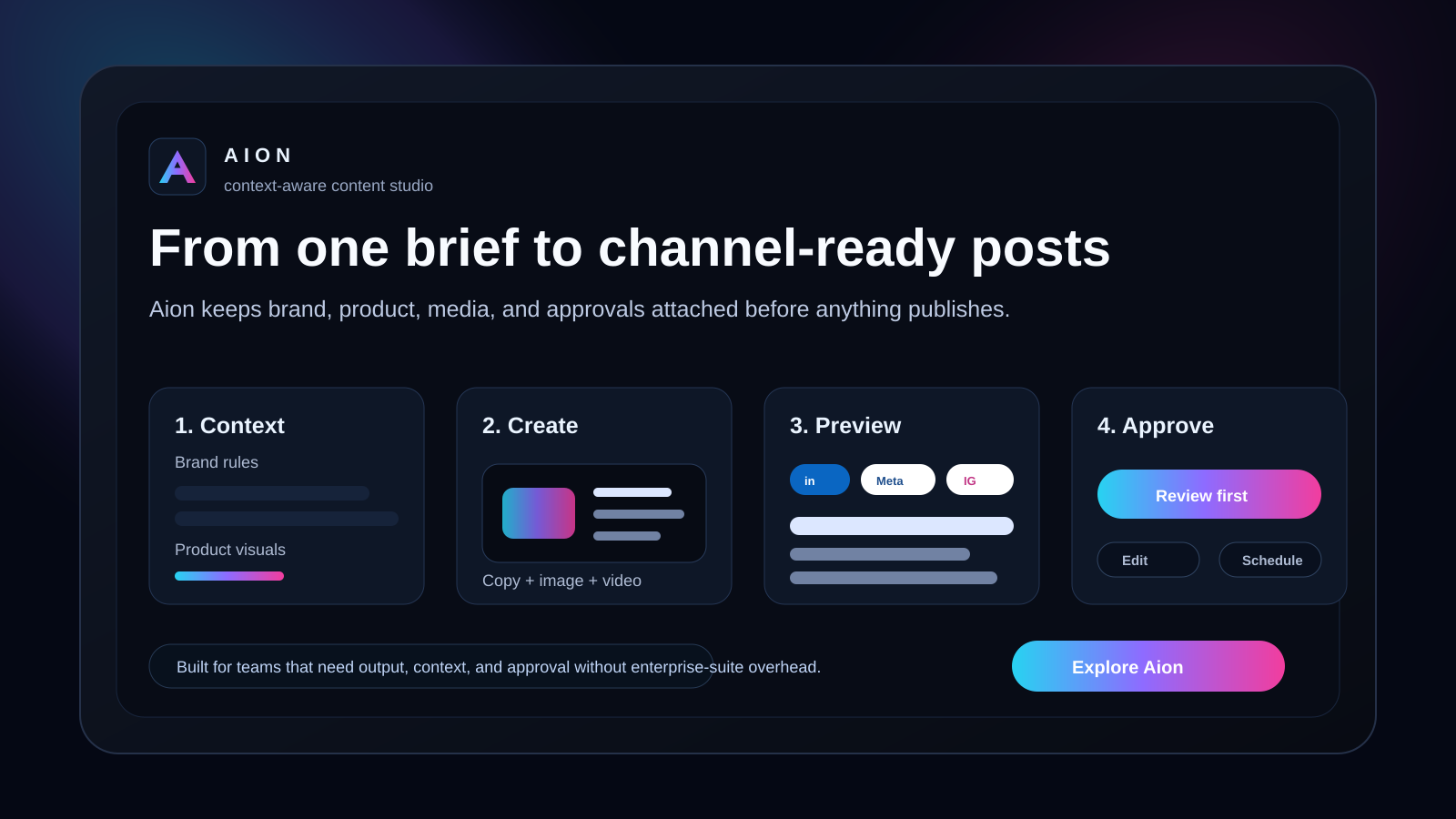
HubSpot shows where social publishing is headed, but lean teams still need context-aware creation, media, previews, approvals, and scheduling without enterprise-suite overhead. That is where Aion fits.
Short answer: HubSpot is strong when a team already runs marketing, CRM, campaigns, contacts, permissions, and analytics inside HubSpot. But many lean teams do not need a full enterprise marketing hub just to create, review, adapt, and publish better social content. That is the gap Aion is built for.
Aion gives teams a context-aware content pipeline: saved brand rules, product/service context, persona guidance, media generation, channel previews, approval-first publishing, and scheduled drafts in one workflow.

What HubSpot Gets Right
HubSpot's social composer shows the direction the market is moving. Teams want to draft once, customize for each network, add media, schedule posts, connect campaigns, and keep social activity tied to the broader customer platform.
That workflow makes sense for companies already standardized on HubSpot Marketing Hub Professional or Enterprise. HubSpot's documentation also makes clear that multi-network publishing comes with real operational details: connected social accounts, permissions, AI settings, network-specific character limits, media rules, link behavior, mention limitations, review, and scheduling.
For an enterprise team, that is a feature set. For an owner-led team, small marketing department, agency, or product operator, it can become overhead.
The Gap: Good Content Still Needs Context
The hardest part of social publishing is not clicking schedule. It is keeping the work aligned.
Teams need to answer the same questions every time:
- What is the brand allowed to say?
- Which product or service is this post about?
- Which claims, screenshots, and proof points are approved?
- Is this post for LinkedIn, Instagram, YouTube, Facebook, or another channel?
- Does each channel preview still match the original intent?
- Who approves it before it goes live?
- What media should go with it?
- Has this angle already been used?
Most tools treat those answers as manual setup. Aion treats them as reusable context.
Where Aion Fits
Aion is not trying to replace every enterprise CRM. It is built for the team that wants the content operating system without the enterprise-suite weight.
Aion helps users create posts, images, and videos from saved context, then review each channel before anything publishes. The workflow is designed around practical content operations:
- Brand context stays attached.
- Product and service context stays attached.
- Persona and voice context can be used when appropriate.
- Media generation is review-first.
- Channel previews are visible before approval.
- Drafts can be scheduled without forcing the team into a giant marketing implementation.
That is the product promise: high-quality content workflows at a fraction of the operational complexity of a full enterprise hub.
Aion vs. The Traditional Social Composer
| Workflow Need | Traditional Social Composer Pattern | Aion Pattern |
|---|---|---|
| Draft one post for multiple networks | Start with shared copy, then customize by channel | Start with user intent plus saved brand, product, and audience context |
| Media creation | Upload or generate assets, then attach them | Generate or reuse images/videos with context attached |
| Brand consistency | Depends on user setup, templates, and review discipline | Brand and product context are first-class inputs |
| Product accuracy | Depends on manually supplied links, screenshots, and copy | Product/service context, visuals, and protected terms guide output |
| Approval | Review before publishing | Approval-first by design |
| Best fit | Teams already committed to a full CRM/marketing hub | Teams that need fast content production without enterprise-suite overhead |
The Aion Workflow
- Add context once: brand, products/services, persona, connected channels, and reusable media.
- Create content from a short brief, topic, media item, product screenshot, or video.
- Let Aion generate a draft, visual, or video using the selected context.
- Preview the content for each channel.
- Edit copy or media without losing the draft session.
- Approve only when the preview matches what should publish.
- Schedule, reuse, or remix the approved asset.
That is the difference between a blank composer and a context-aware studio.
Why This Matters For Search, Answer Engines, And Feeds
The next content advantage is not publishing more posts. It is publishing clearer, better-structured, better-contexted content that machines and people can both understand.
Aion is being built around that reality. A strong article or campaign needs:
- A clear answer near the top.
- Named product and category language.
- Structured headings.
- Source links.
- Visual assets with meaningful alt text.
- A canonical URL.
- Article schema.
- A sitemap entry.
- A fresh-content path for news or feed discovery when the content is timely.
- Consistent internal links to the product page.
That is why this article links directly to Aion, uses a clear comparison structure, and includes sources instead of vague claims.
How To Think About Google News And Feed Discovery
Google News inclusion is not a button. Google says Publisher Center is optional for eligibility, and Google can crawl eligible sites automatically. Publisher Center can still help a publisher manage how it appears. Google's News sitemap documentation is also specific: news sitemaps are for recent articles, and old URLs should be removed from the news-specific feed.
For Full Stack Marketing, the practical play is:
- Publish useful, original posts that answer a real market question.
- Keep the normal sitemap clean.
- Maintain a recent-article news sitemap for timely posts.
- Use article structured data.
- Submit and monitor the site in Google Search Console.
- Add Publisher Center only when the publishing cadence and editorial posture justify it.
- Keep
llms.txtuseful for agents, while treating it as optional discovery support rather than a ranking guarantee.
The Bottom Line
HubSpot is a serious platform for teams that need the full marketing and CRM stack. Aion is for teams that want context-aware content creation, media generation, channel previews, approvals, and scheduling without turning every post into a platform migration.
If your team wants better social content but does not want enterprise-suite overhead, Aion is the gap-filler.
FAQ
Is Aion a HubSpot replacement?
No. Aion is not positioned as a full CRM replacement. It is a content operations layer for teams that need context-aware posts, images, videos, channel previews, approvals, and scheduling.
What makes Aion different from a basic social scheduler?
Aion starts from saved context: brand, product/service, persona, media, and channel intent. The goal is not just to schedule content; it is to generate better content that stays aligned with the business.
Can Aion help with video and image content?
Yes. Aion includes Media Studio workflows for images and videos, with review before approval. The system is designed to keep product and brand context attached to generated media.
How does Aion support answer engine optimization?
Aion's publishing strategy favors direct answers, structured headings, source links, product-specific language, canonical URLs, schema, and reusable context. Those choices help humans and machines understand what the content is about.
Does Google require Publisher Center for Google News?
No. Google's own Publisher Center training says Publisher Center is optional for eligibility, though it can help publishers manage how they appear. Search Console, structured data, quality content, and appropriate sitemaps still matter.
Sources
- HubSpot Knowledge Base: Create and publish social posts
- HubSpot: Marketing Software Pricing
- Google Search Central: Article structured data
- Google Search Central: News sitemaps
- Google News Initiative: Get started on Google News with Publisher Center
- Chrome for Developers: llms.txt